


Dossier ENGIE
Thermal insulating paint: how does it work and when is it really useful?
Are you planning renovation or insulation work in your home? Have you heard of thermal insulating paint? Here’s everything you need to know about this 2-in-1 solution designed to improve wall comfort.

Originally developed from research conducted by NASA to limit thermal transfer on aircraft fuselages, thermal insulating paint is now used in homes as a complementary insulation solution. It does not replace conventional insulation, but it can help improve comfort in certain situations. How does it really work? When is it genuinely useful, and when is it not enough? And how much does it cost? You’ll find all the answers in this article!
Une question sur vos travaux ? Nos conseillers experts sont là pour vous aider
-
Faites-vous rappeler par un conseiller travaux en moins de 2 minutes

Un conseiller va vous appeler au :
Le numéro appelant sera le : 08 00 00 12 02
What is thermal insulating paint?
Thermal insulating paint looks like standard paint, but it contains microscopic ceramic particles that help reduce the sensation of cold walls.
Although it does not replace traditional insulation, it can provide additional comfort, especially when applied to walls facing the outside.
What is thermal insulating paint made of?
Thermal insulating paint is composed of a mixture of:
water-based acrylic paint, as used in most decorative paints,
resins for adhesion,
pigments for colour,
ceramic microspheres, which are the key to its insulating effect.
This final component, inspired by aerospace research, is what gives the paint its insulating properties.
How does thermal insulating paint work?
Unlike “traditional” insulation (External Thermal Insulation ITE, “Isolation Thermique Extérieure” in French and/or internal insulation), which adds thickness to the wall through additional layers, insulating paint works directly on the wall surface.
It blocks heat transfer through the wall, helping reduce heat loss to the outside and contributing to heating savings.
With thermal insulating paint, you experience less of the “cold wall” effect. However, it is not intended to completely transform the overall insulation performance of your home, but rather to improve indoor comfort.
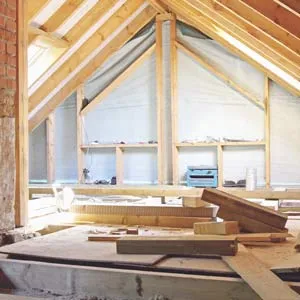
Réalisez des travaux d’isolation à la maison
In which situations is this paint useful (and when is it not enough)?
Thermal insulating paint is especially useful if you want to improve comfort in a room without carrying out major renovation work or losing living space. It acts more like a small “comfort boost”, provided that your home’s thermal envelope is already reasonably efficient beforehand this paint will never work effectively on its own.
Situations where it improves comfort
Thermal insulating paint can provide an extra level of comfort in the following situations, in addition to existing insulation:
on an exterior-facing wall that remains cold to the touch,
in a room sensitive to localised heat loss (office, bedroom, north-facing wall, stairwell),
as a finishing layer on small remaining thermal bridges,
in homes where major renovation work is difficult (exposed beams, small spaces, co-owned buildings, thin walls).
Situations where it is insufficient
On the other hand, thermal insulating paint will not be sufficient if:
your home is generally poorly insulated,
you want to improve overall energy performance (DPE — “Diagnostic de Performance Énergétique”, the French home energy performance rating system — major savings, long-term reduction in bills),
your walls are very thick and/or very cold,
the walls are not the only source of the cold sensation (for example, draughty openings or poorly insulated loft spaces).
If you recognise your situation in these examples, you will need traditional insulation work to achieve a real improvement in energy performance and reduce your bills.
How do you apply thermal insulating paint? Step-by-step guide
Applying thermal insulating paint is very similar to applying standard paint. If you want to carry out the work yourself and ensure maximum effectiveness, here are the key steps to follow.
Prepare the surface
Clean all surfaces thoroughly before painting: a clean surface ensures better adhesion. Make sure there is no dust, grease or old paint residue left behind.
Lightly sand the surface
This step is not mandatory, but lightly sanding the surface with abrasive paper is strongly recommended to improve paint adhesion, especially if the surface is glossy or has been recently painted.
Apply a suitable primer
This helps create a uniform wall surface and optimises the effectiveness of the insulating layer.
Mix the insulating paint
Stir the paint thoroughly for several minutes before application: the ceramic microspheres must be evenly distributed to guarantee the insulating effect.
Apply two coats
Once the primer is dry, apply the first coat of paint. Start by painting the corners with a brush, then use a spray gun or, alternatively, a roller for the rest of the wall.
Allow approximately 6 hours of drying time for the first coat. Once the 6 hours have passed, repeat the process with a second coat of paint. This time, the drying period is longer (at least 12 hours).
Please note that complete drying may take 2 to 3 weeks, which is the time needed for the paint to reach its full performance.
Ensure high-quality installation with a certified RGE professional
The more even the application, the more noticeable the anti-cold-wall effect will be.
If you want optimal results (especially on exterior walls or highly exposed surfaces), it is best to entrust the application to a certified “Reconnu Garant de l’Environnement” (RGE) professional, a French government-recognised certification for energy renovation specialists.
This is also a requirement for applying for French government grants and energy supplier financial support schemes.
The advantages of thermal insulating paint
Thermal insulating paint is becoming increasingly popular, particularly because of its ease of use and simple application.
Easy to apply and suitable for many surfaces
Like standard paint, it can be applied without major renovation work on wood, concrete, metal, PVC and many other materials.
No loss of living space
It improves insulation without adding extra thickness, which is particularly useful in small rooms or already optimised living spaces.
Improved overall comfort
In addition to reducing the sensation of cold walls, the paint also improves the home’s acoustic insulation. It can also help regulate humidity levels in a room and reduce condensation and mold.
Suitable for both indoor and outdoor use
Thermal insulating paint can be used for both interior and exterior insulation purposes. For outdoor use, simply make sure you choose a paint specifically designed to withstand weather conditions.
A durable paint, both over time and environmentally
When properly applied, insulating paint can remain effective for up to 45 years. In addition, its composition is generally considered environmentally friendly.
Is thermal insulating paint dangerous to health?
Thermal insulating paint does not present any particular health risks. It is formulated like a standard acrylic paint, with the addition of ceramic microspheres responsible for the insulating effect.
The limitations and disadvantages of thermal insulating paint
Although it offers many advantages, insulating paint is not a “structural” insulation material.
This is its main drawback: on its own, it cannot replace traditional insulation if your home suffers from significant heat loss. As a result, its impact on energy performance remains moderate.
Another disadvantage is that the comfort result depends heavily on the quality of the application (thickness and uniformity). So, even though it is technically possible to apply it yourself, professional installation is often necessary in practice to ensure optimal performance.
Finally, its purchase cost is higher than standard paint, especially if you need to cover a large area. In addition, thermal insulating paint always requires at least two coats to be effective.
Advantages |
Limitations / Disadvantages |
|---|---|
Applied like standard paint |
Does not replace traditional insulation (ITE, ITI) |
Reduces the sensation of “cold walls” |
Limited energy savings |
No loss of interior space |
Little or no impact on the DPE |
Suitable for many surfaces |
More expensive than standard paint |
Can be used indoors and outdoors |
Requires at least 2 coats |
Good complementary insulation solution |
Results depend on application quality (professional recommended) |
Average price per litre |
Coverage per litre |
Price per m² (for two coats) |
|---|---|---|
€30 to €60 / L |
4 to 8 m² per litre |
€7.5 to €30 per m² |
For a 10 m² room (around 30 m² of wall surface to paint, assuming one door and one window), expect to pay between €225 and €900 for paint alone, excluding labour.
If you hire a certified professional, remember to add labour costs to the final budget: between €30 and €40 per working hour (approximately €30/m²). Most professionals include both materials and installation in their overall quote.
These prices remain estimates based on prices commonly found in major DIY stores and specialist websites. It is always advisable to request several quotes before starting your renovation work in order to estimate the final cost per m² more accurately.
Good to know
To increase effectiveness without increasing your budget, it is best to apply this paint primarily on walls in direct contact with the outside (north-facing walls, cold façades, poorly heated rooms). These are the areas where the comfort improvement will be most noticeable.
Can you receive financial support for insulating your home with thermal insulating paint?
Thermal insulating paint itself is not eligible for direct financial aid. However, wall insulation work, such as internal wall insulation, may qualify for financial support schemes such as MaPrimeRénov’ (French government energy renovation grant) or the “Certificats d’Économies d’Énergie” (CEE — Energy Savings Certificates scheme in France). Please note that some grants are subject to conditions, such as the requirement to use an RGE-certified professional.
Simulate your eligibility and
the amount of financial aid
Is thermal insulating paint actually effective?
Thermal insulating paint is effective as a complement to another insulation method, when used on targeted areas to improve everyday comfort.
It is not designed to solve a major insulation problem or significantly reduce heating consumption. If your home is highly energy-intensive, more comprehensive insulation work will be required.
In addition, its effectiveness depends greatly on the quality of application, including the minimum required thickness and correct application techniques, which is why hiring a professional is strongly recommended.
What are the main thermal insulating paint brands?
Several brands now offer insulating paints, with product ranges designed for indoor use, outdoor use, or both:
Theotherm, widely available on the market,
Korund, a well-established and proven brand,
Rubson, a brand specialising in home sealing products,
Julien, known for primers and interior/exterior paints.
Before purchasing, check:
whether the paint is suitable for indoor or outdoor use;
the coverage per m² (which varies between brands);
the application conditions (temperature, surface type, humidity);
the advertised durability.
Key takeaways about thermal insulating paint
Thermal insulating paint is an acrylic paint made with resins and ceramic microspheres that provide its insulating properties.
Its application process is identical to standard paint, except that it requires longer drying times. It is also recommended to use an RGE-certified professional for installation.
The price of thermal insulating paints varies depending on the brand. Expect to pay on average between €30 and €50 for one litre of indoor thermal insulating paint. Several brands are available in DIY stores and online, including Theotherm, Korund and Rubson.
By hiring an RGE-certified professional, you may be eligible for financial support for your energy renovation work.
Thermal insulating paint is a complementary solution used alongside more traditional insulation methods. When used alone, its effectiveness remains limited.
The effectiveness of thermal insulating paint can last up to 45 years for certain products, provided it has been correctly applied.
To protect against humidity, the ideal solution is to use a waterproof insulating paint. This type of paint is effective both indoors and outdoors, as well as in damp environments such as bathrooms, cellars and basements.
To strengthen your home’s thermal insulation, it is important to use additional, thicker insulation materials such as polyurethane, cork, hemp, rock wool or glass wool.