


Dossier ENGIE
The Ideal Temperature for Your Home: Room-by-Room Recommendations
Recommended temperatures vary depending on the room and its purpose. For living spaces such as the living room, dining room, kitchen, and home office, the recommended temperature is 19°C. Bedrooms should ideally be kept at 16°C, while bathrooms should be maintained between 17°C (when unoccupied) and 22°C (when in use). However, the ideal temperature for a home ultimately depends on individual comfort preferences and lifestyle.
ENGIE shares practical guidelines, useful tools, and helpful tips to help you balance comfort, wellbeing, and energy savings.

Adjusting temperatures according to each room in your home
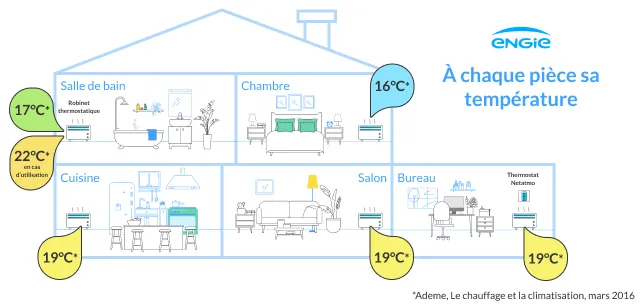
For optimal comfort and greater energy savings, you can adjust the temperature of your home according to how each room is used. Living spaces should generally be heated to 19°C, bedrooms should not exceed 16°C, and bathrooms can be kept at either 17°C or 22°C depending on whether they are being used.
All that remains is to discover ENGIE's recommendations below to better understand the reasoning behind these room-by-room temperature settings.
Did you know?
According to French consumers, 20°C is considered the average ideal indoor temperature for feeling comfortable at home without feeling cold.
Découvrez les supers pouvoirs de Ma conso+
Passez à l’action pour réduire vos consommations d’électricité
Pour seulement 2,99€TTC / mois
Choosing the ideal temperature room by room: balancing comfort and energy savings
1. Living areas: 19°C for the living room, dining room, kitchen, and home office
The recommendation established by the French Construction and Housing Code (Code de la construction et de l’habitation) is straightforward: the temperature in living areas including the living room, dining room, kitchen, and home office should be limited to 19°C. In reality, however, comfort levels vary. If you are actively cooking in the kitchen or sitting down to watch a film, the temperature you perceive will not be the same. The same applies if your home is particularly humid or benefits from strong southern exposure.
Every degree matters. For example, lowering your heating by just 1°C can reduce your energy consumption by approximately 7%(2), while increasing it has the opposite effect. Over the course of a year, these energy savings can make a meaningful difference both to your household budget and to the environment.
2. The bedroom: 16°C, the ideal temperature for restorative sleep
In bedrooms, 16°C(3) is the temperature recommended by ADEME (France's Agency for Ecological Transition). Combined with suitable bedding and a warm duvet, it helps promote restorative sleep and a more comfortable wake-up experience.
Closing shutters, blinds, and curtains properly can also help limit heat loss. Do you enjoy reading before going to sleep? A hot water bottle can significantly improve your comfort without increasing heating costs.
For babies' bedrooms, the recommended temperature is slightly higher between 18°C and 20°C because newborns do not fully regulate their body temperature during their first months. The same recommendation applies to young children, who often uncover themselves during the night.
It is also important to air your rooms for a few minutes every day. This healthy habit improves indoor air quality while having only a minimal impact on energy consumption.
3. The bathroom: between 17°C and 22°C for this occasionally used room
Certain rooms require different temperature settings depending on how they are used and who uses them. In a bathroom, 19°C is generally not sufficient to feel comfortable when stepping out of a bath or shower, yet it is unnecessary to maintain a higher temperature all day long.
A practical solution is to heat the bathroom to 22°C when it is in use and reduce the temperature to 17°C the rest of the time. The same recommendation applies to toilets and circulation areas such as hallways.
An added bonus? A heated towel rail or fan heater can warm the room within just a few minutes.
Still feeling chilly?
For additional comfort, consider putting on a jumper or using a blanket before increasing the thermostat. You may also wish to use a small portable heater as a supplement to your central heating system.
Have you chosen the ideal temperature for your home? Now it's time to regulate it effectively!
At night, in unused living areas, or during daytime absences, 16°C is generally sufficient. During longer periods away from home, temperatures can even be lowered to 12°C provided your heating system raises the temperature again in time for your return.
To avoid wasting energy while maintaining optimal comfort, programmable heating controls are essential. Fortunately, there are several effective solutions available:
Thermostatic radiator valves: installed directly on radiators, they maintain the chosen temperature according to room occupancy and any free heat gains, such as sunlight.
Smart thermostats: these allow you to control and programme your heating remotely, helping you adapt consumption to your lifestyle.
Outdoor temperature sensors: these measure the outside temperature and transmit the information to your boiler, enabling it to anticipate weather changes and automatically adjust indoor temperatures according to your needs.
Check your home's energy efficiency
In addition to adjusting room temperatures and installing a smart thermostat, it is important to assess your property's energy performance to understand how efficiently it uses energy.
To support you with this process, ENGIE specialists are available on 09 69 32 34 35, Monday to Friday, from 9:00 a.m. to 6:00 p.m.
On average, maintaining rooms at around 18°C helps support your body's natural temperature regulation. However, sleeping in a bedroom maintained between 16°C and 18°C generally promotes higher-quality sleep. Ultimately, the ideal temperature is the one that feels most comfortable to you.