


Dossier ENGIE
What Is the Electricity and Water Consumption of Your Washing Machine?
Do you want to know how much electricity and water your washing machine consumes? That is a great initiative, as this appliance is often one of the most energy- and water-intensive in the home. By better understanding its consumption, you can make significant savings. To estimate how much water and electricity your washing machine uses, follow our guide.

According to ADEME (France’s Agency for Ecological Transition), laundry washing and drying account for 6.4% of household electricity bills. This is a relatively significant share of household energy consumption.
Do you want to understand your washing machine’s consumption? This is a smart step, as this appliance can be quite energy- and water-intensive. By better managing its usage, you can reduce your bills. To estimate how much electricity and water your washing machine consumes, follow this guide.

Rejoignez le 1er fournisseur d'électricité verte en France
Pour votre électricité, ENGIE vous accompagne au quotidien avec un service client disponible 7 jour sur 7, même le dimanche.
What is the average consumption of a washing machine?
A washing machine uses both water and electricity to operate. On average, a French household runs 183 wash cycles per year(1). Given that one wash cycle uses around 50 litres of water and requires 1 kWh of electricity, operating a washing machine throughout the year represents a significant cost on both water and energy bills.
You may also be interested in this article: household appliances – what is their impact on energy consumption?
Average electricity consumption of a washing machine
A study conducted by ADEME(2) shows that in France, a washing machine consumes on average 191 kWh per year, or 16 kWh per month and 0.5 kWh per day.
Average water consumption of a washing machine
A washing machine also consumes a significant amount of water, which can impact household bills. Today, one wash cycle is estimated to use around 50 litres of water (compared to 100 litres in the past)(3).
What factors influence washing machine consumption?
The figures above are averages. Several factors can significantly affect a washing machine’s consumption.
Energy efficiency rating
First, the performance of the appliance plays a major role. To assess it, you should look at its energy label.
Energy labels help consumers identify the most energy-intensive washing machines using a rating system from A (most efficient) to G (least efficient).
Here are three examples of electricity consumption based on energy classes (A being the most efficient and G the most energy-intensive):
Energy class |
Average electricity consumption per cycle |
Average electricity consumption per 100 cycles |
Cost for 100 cycles at regulated electricity tariff (base rate – November 2022) |
|---|---|---|---|
Class A |
0.31 kWh |
31 kWh |
€5.39 |
Class B |
0.52 kWh |
52 kWh |
€9.05 |
Class C |
0.63 kWh |
63 kWh |
€10.96 |
Class D |
0.69 kWh |
69 kWh |
€12.01 |
Energy labels: a revised classification since March 2021
Energy rating systems were updated in March 2021. The old A+, A++ and A+++ labels have been replaced by a simplified A to G scale to make it easier for consumers to understand.
In addition to energy efficiency, the new labels also provide information on noise levels during spinning cycles and the duration of eco programmes.
Water temperature
Another key factor affecting energy and water consumption is wash temperature. Higher temperatures are often used for heavily soiled laundry, but these programmes consume significantly more energy.
Conversely, washing at low temperatures or even cold cycles helps reduce electricity consumption.
As ADEME states: “washing laundry at 30°C uses three times less energy than washing at 90°C and twice less than at 60°C.”
Wash cycle speed
Cycle speed also influences consumption. Faster wash cycles require water to be heated more quickly, which is energy-intensive.
However, slower cycles increase overall duration, which also consumes energy. The key is to find the right balance between cycle speed and duration.
How to calculate your washing machine’s consumption
Knowing average consumption helps estimate the impact of your washing machine on your energy bill. But how can you calculate it more precisely?
Calculating electricity consumption
The first step is to check your appliance’s energy label. Manufacturers now indicate energy consumption per 100 cycles. You can also refer to the user manual, which often provides kWh per cycle.
This is the most reliable method. Simply multiply consumption per cycle by the number of cycles over a given period.
For example, if you run 260 washes per year (5 cycles per week) with a machine consuming 60 kWh per 100 cycles, your annual consumption is: 0.6 × 260 = 156 kWh per year.
If you do not know consumption per cycle, you can estimate it using the general electricity consumption formula:
(number of hours × number of days or weeks × power in watts) / 1,000
For example, a 2,200 W washing machine used for 5 cycles of 1.5 hours per week (7.5 hours total):
(2,200 × 7.5 × 52) / 1,000 = 858 kWh
However, this figure is overestimated because it assumes the machine runs at full power continuously. In reality, power varies throughout the cycle. That is why manufacturer data is always more accurate.
To calculate cost, multiply consumption by your electricity price per kWh (found on your bill, and possibly variable under peak/off-peak tariffs).
Calculating water consumption
Water consumption is also indicated on the energy label. It is usually based on a cotton 60°C cycle at full load(4), making it the most reliable reference.
If your machine is older or lacks a label, consumption typically ranges between 40 and 80 litres per cycle. Use higher values (65–70 L) for older large machines and lower values (45–50 L) for smaller ones.
To estimate annual consumption:
water per cycle × 52 weeks × number of weekly cycles
For example:
55 × 52 × 5 = 14,300 litres per year
To estimate cost, multiply by the average price of water, around €0.0042 per litre(5), giving:
14,300 × 0.0042 = €60.06 per year
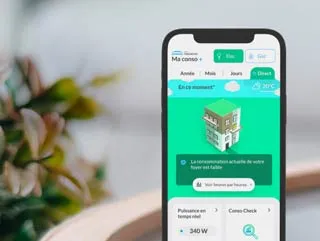
Découvrez les supers pouvoirs de Ma conso+
Passez à l’action pour réduire vos consommations d’électricité
Pour seulement 2,99€TTC / mois
How to reduce washing machine consumption
Since laundry represents a significant share of energy bills, several actions can help reduce costs.
Monitor your electricity consumption
Understanding your consumption is key. Studies show that monitoring energy use can reduce consumption by up to 23%(7). The more aware you are, the less you consume.
ENGIE offers tools such as Ma Conso and Ma Conso+, which allow you to track your energy usage daily or in real time.
Use off-peak hours
If your machine has a delayed start function, you can run cycles during off-peak hours when electricity is cheaper.
Invest in an energy-efficient washing machine
A higher-quality appliance may be more expensive initially but can quickly become cost-effective thanks to lower energy and water consumption.
Choose the right model for your needs
Oversized machines often lead to unnecessary consumption. A 6 kg washing machine is usually sufficient for a household of 2 to 3 people.
Washer-dryers should also be used carefully, as drying is particularly energy-intensive and often limited to 50–60% of washing capacity.
Adopt eco-friendly habits
Simple habits can reduce your bill:
avoid pre-wash cycles;
wash at 30°C whenever possible;
fill the drum before starting a cycle;
use eco or short programmes;
clean filters and seals regularly;
air-dry clothes instead of using a dryer;
turn off the machine after use.
Washing machine consumption: key takeaways
On average, a washing machine consumes 50 litres of water per cycle and 191 kWh of electricity per year. These figures vary depending on appliance type, energy label, and usage habits.
Simple calculations can help estimate consumption, but digital tracking tools provide more accurate monitoring.
Although washing machines represent a significant household expense, several eco-friendly habits can help reduce both water and electricity consumption.
Electrical power is measured in watts (W) and indicates the energy required for the appliance to operate for one hour. Washing machines typically range between 1,000 and 2,500 W.
Using a washing machine is not necessarily harmful to the environment. In fact, appliances are often more efficient than manual washing. The most effective way to reduce environmental impact is to use eco modes, which save both water and energy.
Always refer to the energy label. Since March 2021, the A–G rating system helps consumers easily identify energy-efficient appliances. Prefer A or B-rated machines over C, D, F, or G models to reduce household energy consumption.